
Cockapoo Parent Dogs: What Future Owners Should Learn
Choosing a Cockapoo puppy involves more than comparing coat colors or looking at photographs. A puppy’s parents can offer useful clues about its likely size, coat, temperament, and health risks. Therefore, prospective owners should learn about Cockapoo parent dogs before making a final decision.
Cockapoos come from Cocker Spaniel and Poodle parentage. However, individual puppies can inherit different combinations of traits. No breeder can predict every detail with complete certainty. Still, meeting or learning about the parents can help families form more realistic expectations.
Why Puppy Parents Matter
Genes influence many aspects of a dog’s development. These include physical appearance, adult size, coat texture, body structure, and susceptibility to certain inherited conditions.
Environment also matters. Nutrition, socialization, training, exercise, and veterinary care can shape a puppy’s development. As a result, owners should consider both genetics and early care.
Responsible breeders study their dogs before planning a litter. They consider health, temperament, structure, age, and family history. They should also explain why they selected a particular Cocker Spaniel and Poodle pairing.
Parent Dogs Provide Useful Clues
Looking at the puppy’s parents may help you estimate:
- The puppy’s likely adult size
- Possible coat texture and shedding level
- General energy level
- Confidence around people
- Physical structure
- Grooming requirements
- Potential inherited health concerns
These observations offer guidance rather than guarantees. A puppy may resemble one parent more strongly than the other. In addition, littermates can develop different personalities and physical traits.
Learn About Both Sides of the Family
A Cockapoo puppy receives genetic material from both parents. Therefore, buyers should ask about the Cocker Spaniel and the Poodle.
Do not focus only on the mother because she is present with the litter. Ask the breeder for information about the father as well. Request photographs, health information, size details, and temperament notes when an in-person meeting is not possible.
You can also ask whether the breeder owns both parents. Some breeders use an outside stud. That practice is not automatically a warning sign. However, the breeder should still have reliable information and documentation about the sire.
Families researching a breeding program can learn more from the PuffNStuff Cockapoo breeder website.
What Cockapoo Parent Dogs Can Reveal About Size
Cockapoos do not have one fixed adult size. Their final size depends partly on the size of the Poodle parent and the physical characteristics inherited from both sides.
Ask for the height and weight of each parent. Also, request information about previous puppies from the same bloodlines. Adult offspring from earlier litters may provide additional insight.
However, avoid breeders who promise an exact adult weight. Growth depends on genetics, sex, nutrition, health, and individual development.
A breeder should provide an estimated range instead of a guaranteed number.
Size Should Match Your Lifestyle
A smaller Cockapoo may suit apartment living or frequent travel. Meanwhile, a larger and more energetic dog may fit an active household with more space.
Size also affects practical matters such as:
- Food portions
- Exercise requirements
- Crate size
- Travel arrangements
- Grooming costs
- Ease of lifting and handling
Therefore, discuss your home and routine with the breeder before choosing a puppy.
Study Temperament, Not Just Appearance

Temperament can affect daily life more than coat color. A beautiful puppy may still struggle in a home that does not match its energy level or emotional needs.
Observe how the parents respond to people, new sounds, gentle handling, and unfamiliar surroundings. A calm and friendly parent may offer encouraging information. However, remember that training and early experiences also influence behavior.
Ask the breeder whether either parent shows:
- Persistent fearfulness
- Uncontrolled aggression
- Extreme nervousness
- Resource guarding
- Severe separation distress
- Difficulty recovering after stress
One nervous moment does not define a dog’s entire temperament. Still, repeated or intense behavior deserves careful discussion.
Ask About Health Screening
Physical appearance cannot confirm genetic health. A dog may look healthy while carrying an inherited condition.
Therefore, ask which health evaluations the breeder completed before breeding. Request written results where appropriate. The testing should reflect the health concerns associated with both Cocker Spaniels and Poodles.
The American Kennel Club advises buyers to ask about the health of both parents and request proof of relevant health screening. It also recommends visiting the breeder’s home or kennel and seeing at least one parent when possible. Review the AKC’s responsible breeder guidance for additional questions to consider.
Understand What Testing Can and Cannot Do
Health screening can reduce avoidable risks. However, it cannot guarantee that a puppy will never develop a medical condition.
Genetic tests may identify whether a dog carries certain inherited variants. Other evaluations examine the eyes, heart, hips, joints, or general physical health.
Different tests answer different questions. Therefore, ask the breeder to explain:
- Which tests were completed
- Why those tests were selected
- When the tests were performed
- What the results mean
- Whether follow-up examinations are required
- How the results influenced the breeding decision
A responsible breeder should explain the results clearly. They should not simply state that the parents are “vet checked” without providing further details.
Review Family History and Previous Litters
One test result provides useful information. However, a broader family history may reveal patterns that one examination cannot show.
Ask about the parents’ siblings, previous offspring, and older relatives. Find out whether previous puppies developed recurring health or behavioral concerns.
Breeders who maintain bloodlines over several generations may have more information about how their dogs mature. Still, they should document and evaluate those observations carefully.
Prospective owners can review the breeder’s Cockapoo parent dogs to learn about the dogs behind the breeding program.
Coat Traits Can Vary
Cockapoo coats may appear curly, wavy, or relatively straight. They can also vary in thickness, softness, grooming needs, and shedding.
Looking at the parents can provide clues. However, coat development may continue as the puppy matures. The puppy’s adult coat may differ from its early puppy coat.
No breeder should promise that a puppy will be completely hypoallergenic. People react to proteins found in dog dander, saliva, and urine—not only loose hair.
Families with allergies should spend time around similar adult dogs before making a commitment. They should also consult a medical professional about serious allergy concerns.
Questions to Ask the Breeder
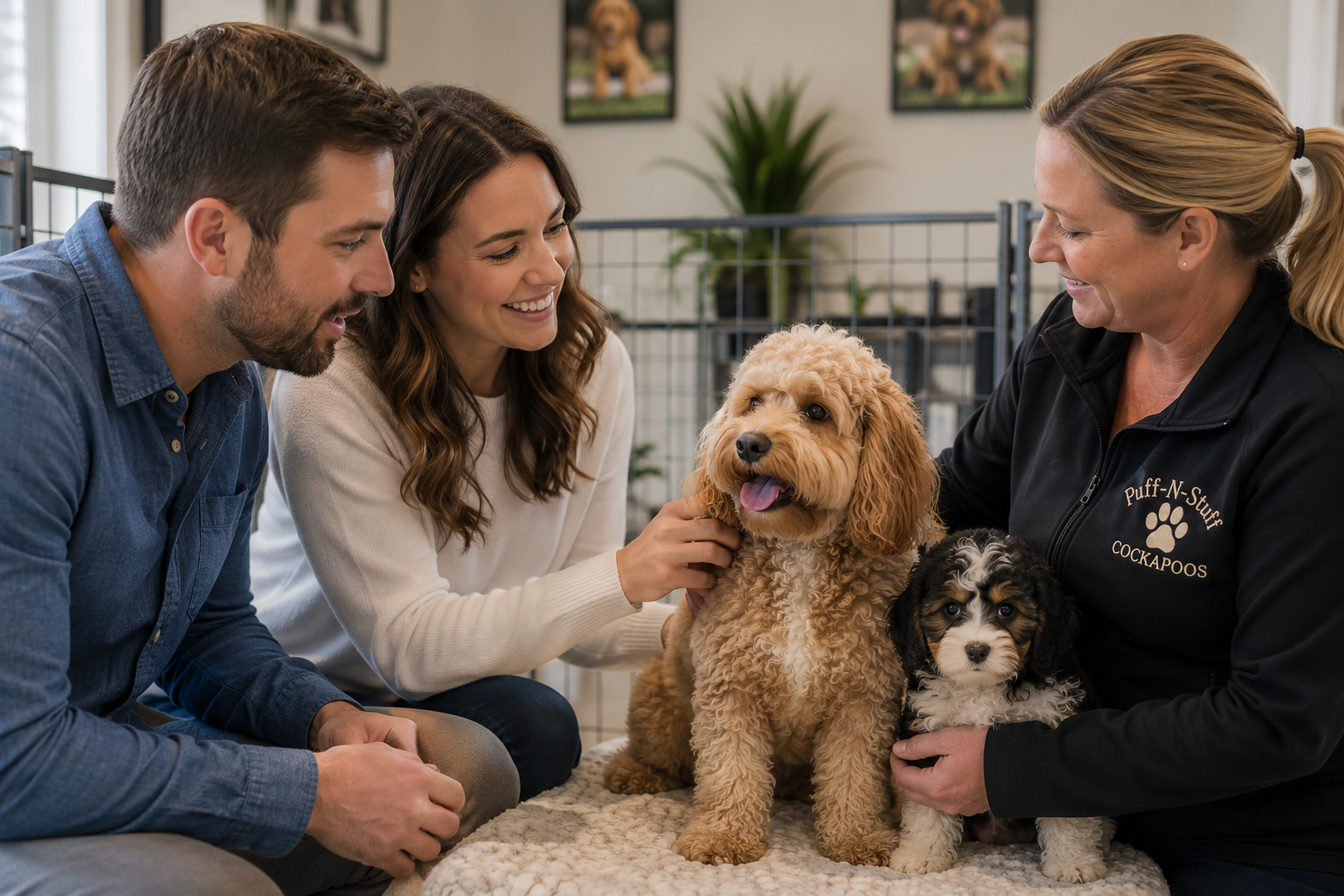
Prepare your questions before contacting a breeder. A written list helps you compare answers fairly.
Useful questions include:
- What are the parents’ ages, sizes, and temperaments?
- Which parent does this puppy currently resemble?
- What health screenings have both parents completed?
- Can I review the documented results?
- Have these dogs produced previous litters?
- How did puppies from earlier litters develop?
- Are there known health concerns in either family line?
- Where do the parent dogs live?
- Can I meet at least one parent?
- Why did you choose this particular pairing?
A knowledgeable breeder should answer reasonable questions without creating pressure. In addition, responsible breeders often ask buyers about their homes, routines, children, other pets, and experience with dogs.
Watch for Warning Signs
Exercise caution when a breeder:
- Refuses to discuss the parents
- Provides no health documentation
- Promises perfect lifelong health
- Guarantees an exact adult size
- Focuses only on unusual colors
- Will not explain the breeding decision
- Pressures buyers to pay immediately
- Keeps adult dogs in poor conditions
- Avoids questions about temperament
- Always has many unrelated breeds available
One concern may have a reasonable explanation. However, several warning signs should cause you to reconsider.
Make an Educated Decision
Learning about Cockapoo parent dogs helps prospective owners look beyond puppy photographs. Parent health, size, structure, temperament, and family history can provide valuable context.
However, parents represent only part of the picture. Buyers should also review puppy socialization, veterinary records, living conditions, breeder policies, and ongoing support.
Take time to compare information. Ask for documentation. Finally, choose a breeder who communicates openly and prioritizes the long-term welfare of every dog.
An informed decision creates realistic expectations. More importantly, it gives the puppy and its new family a stronger foundation for life together.
 Finding truly